
Finding Residents in Leesburg
The best route depends on what is known. Put an address in the Lake County Property Appraiser search. A name may work there too, but a common name needs more proof. The Lake County Clerk’s official-record index can show deeds and other recorded instruments. Its court index has a separate party search. For an older household, Leesburg Public Library collections and historical directories add detail that current rolls cannot supply.
Save spelling, dates, parcel numbers, book and page citations, and each person’s role. An owner, voter, court party, corporate officer, and directory resident are not the same thing. Each is evidence of a distinct link at a distinct date.
- Search a known name or situs address in the property roll.
- Save the parcel number, alternate key, legal description, and deed citation.
- Check official-record and court indexes with name variants.
- Use voter data through its personal lookup or request channel.
- Use directories, maps, newspapers, and archives for an older trail.
Leesburg Residents Records Offices
Leesburg is not the Lake County seat. The city clerk handles commission records, contracts, annexations, easements, and development documents. County offices in Tavares keep deeds, court cases, voter administration, and much of the tax-roll trail. A request should name the subject, record type, date range, spelling, and preferred format. Florida law does not require a requester to explain a purpose.
Lake County Recording Division
550 W. Main Street, North Wing, third floor
Tavares, FL 32778
352-253-2600
Lake County Property Appraiser
Owner, parcel, situs, and values
Lake County, Florida
352-253-2150
City Hall at 501 W. Meadow Street is the municipal starting point. For a full address method, use the Leesburg street directory.
Start With Leesburg Property Records
The Property Appraiser is the clearest bridge between a name and a place. Its search accepts owner name, address, alternate key, and parcel number. Enter an owner as last name followed by first name, without a comma. Partial names help when an initial or suffix differs.
A result can show owners, mailing address, physical property location, legal description, subdivision or lot, values, exemptions, improvements, sales, and related links. The physical location is the situs address. The mailing address is where tax mail goes. They may differ, and neither proves who occupies the property.
- Parcel
- A mapped unit of land with a county identifier.
- Alternate key
- A compact Lake County key used between record systems.
- Situs
- The land’s physical address, not the tax mailing line.
- Legal description
- The recorded land identity used when street labels change.
Open the Lake County Property Appraiser search shown below.
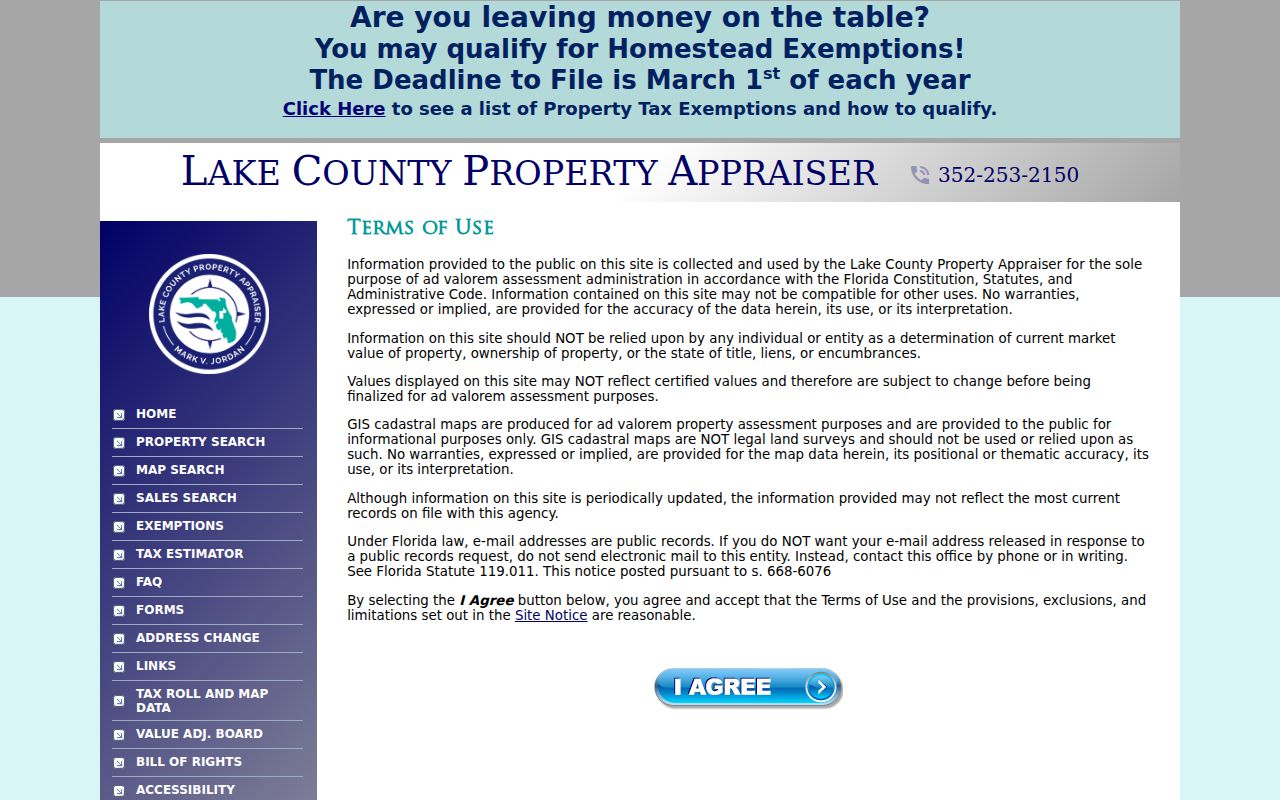
Use its exact owner spelling and parcel key to reduce errors in later records.
Leesburg Records Beyond the Web
The Clerk’s research room reaches back to Lake County’s 1887 creation through books, microfilm, and digital images. Deed books cover 1887 through 1956, while Official Records run from 1957 forward. Plats reach 1884. Marriage, tax-deed, patent, road-map, and military-discharge books have separate ranges.
Search by party name, clerk file number, book and page, document type, or recording dates. A grantor gives an interest; a grantee receives it. If an image is absent, take the citation to the Recording Division. Staff can explain equipment but cannot conduct title or lien searches.
| Channel | Best use | Limit |
|---|---|---|
| Official Records | Names, types, dates, citations | Some images are not online |
| Research room | Books and microfilm to 1887 | Researcher runs the search |
| FamilySearch | Deed indexes, 1887 to 1927 | Login or affiliate access may apply |
| Storage Facility | Inactive county files | Focused retrieval is needed |
Open the Official Records index to see the online start.
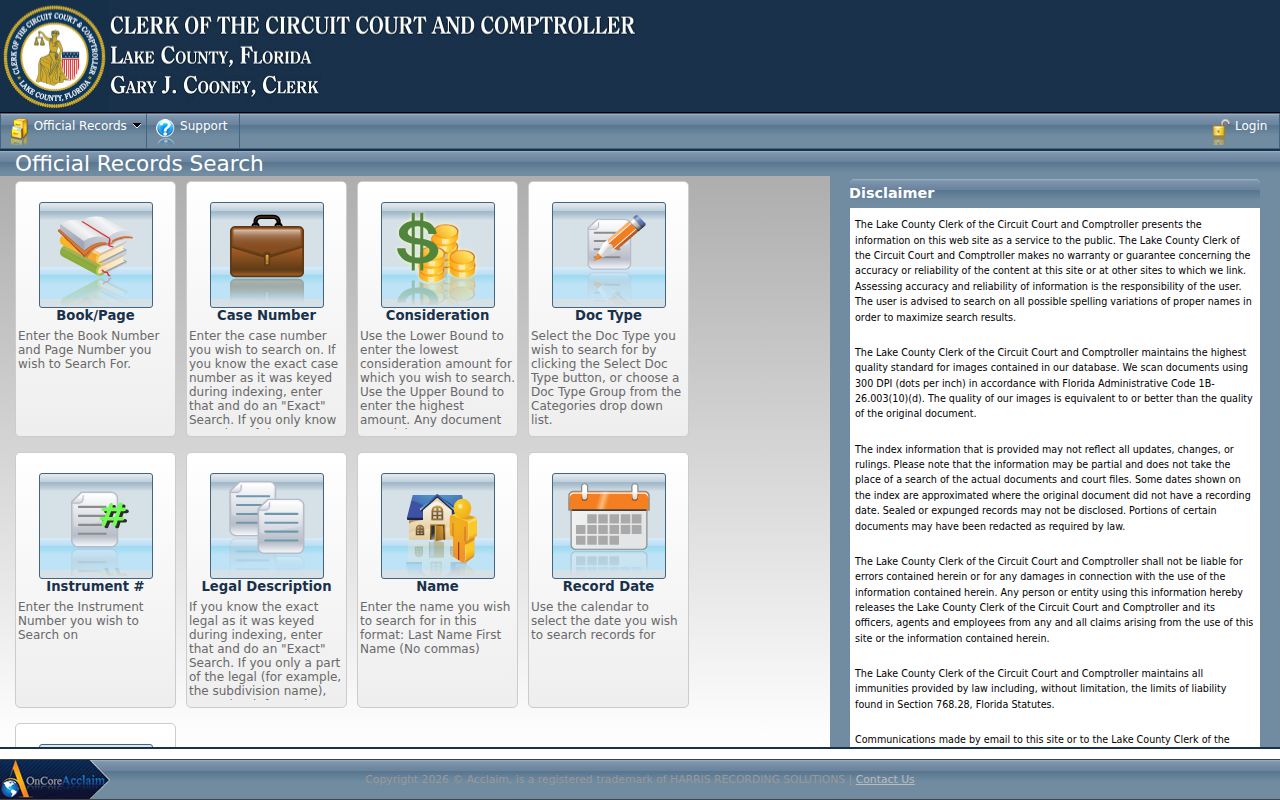
The result is an index, not always a full document or certified copy.
Note: A record missing online may remain in a Tavares book, microfilm reel, stored file, or controlled image channel.
Current Leesburg Residents Directory Sources
No official master roll covers all Leesburg residents. Each source records an event or role. Property records identify owners. Voter data concerns registered voters. Recorded instruments and dockets identify named parties. Business and license records show affiliations, not a home.
| Source | What it confirms | Keeper | Access |
|---|---|---|---|
| Property roll | Owner, situs, parcel | Property Appraiser | Free search |
| Voter record | Status and lawful fields | Supervisor of Elections | Lookup or request |
| Recorded documents | Parties, role, date, land | Lake County Clerk | Index and counter |
| Court cases | Role, case, docket | Lake County Clerk | ShowCase or request |
| Local history | Past people and places | Public Library | Digital and onsite |
Compare two independent records for one person. The Leesburg resident lookup gives that focused workflow.
Voter Records for Leesburg Residents
The Lake County lookup is a personal verification tool. First name, last name, date of birth, agreement, and CAPTCHA are required. A match may show registration, precinct, election details, sample ballot, mail-ballot status, and recent participation. Participation shows that someone voted, never a ballot choice.
The public voter file is a different channel. A narrow request should state geography, fields, format, snapshot date, and lawful use. The Supervisor’s NextRequest portal accepts requests. Social Security and license numbers, signatures, preregistrant data, registration-location details, and protected voter data are withheld.
Leesburg Court Lookup Channels
Lake County courts use ShowCase Web. Public users search without an account by party or case number and can narrow by case type and filing dates. Public tabs may list parties, charges, events, dockets, sentences, bonds, linked cases, and fees.
Anonymous users see public material. Registered users sign an agreement and may gain role-based image access. Parties can sometimes see more of their own files. Sealed and expunged cases remain unavailable. Cases before 2003 generally lack online images, and traffic categories have later image cutoffs.
When the portal stops, submit the written form by mail, email, or at the East Wing counter. The published charge is $2 per calendar year per name, plus listed delivery costs. Prepayment is required, and processing is stated as seven to ten business days.
View Lake County court search before requesting paper research.
A hit confirms a role in a case, not identity by name alone and not guilt.
Vital Records for Leesburg Residents
Florida birth, death, marriage, and divorce records follow distinct rules. Birth records younger than 125 years are restricted to eligible people. Death records without cause have broader access, while cause of death is restricted for 50 years. Marriage and divorce certifications from 1927 forward are state products, but Lake County keeps the license or court file.
DOH-Lake provides eligible Florida births from 1930 and electronically available Florida deaths from 2009 at 2113 W. Griffin Road. It describes in-person service as about 15 minutes. Listed fees are $15 for the first birth copy, $10 for another, and $12 for a death copy. State service reaches beyond the local electronic window.
The Florida Vital Statistics gateway links forms and rules.
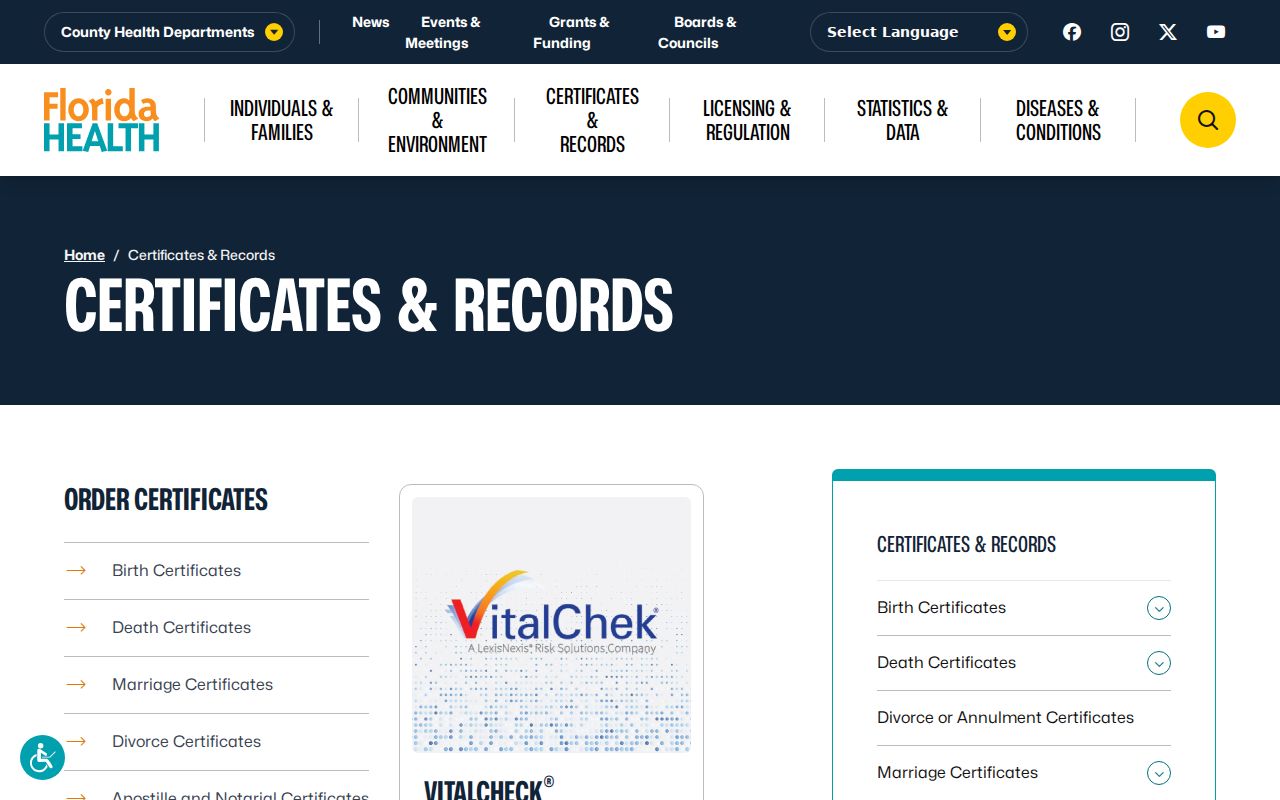
Choose between a certification, county file, and historical index before paying.
Leesburg Library Resident Indexes
Leesburg Digital Collections hold directories, newspaper excerpts, yearbooks, oral histories, maps, photos, Project Collect, service scrapbooks, and local publications. These sources can connect a name to a school, relative, unit, business, or community event missing from a deed.
The library is a FamilySearch Affiliate. Catalog images marked with a key may open at its terminals though not at home. Kinseekers offers free, appointment-free help on Wednesdays from 10 a.m. to 1 p.m. Bring names, an approximate year, and an address or subdivision.
Browse Leesburg Digital Collections to see the groups.
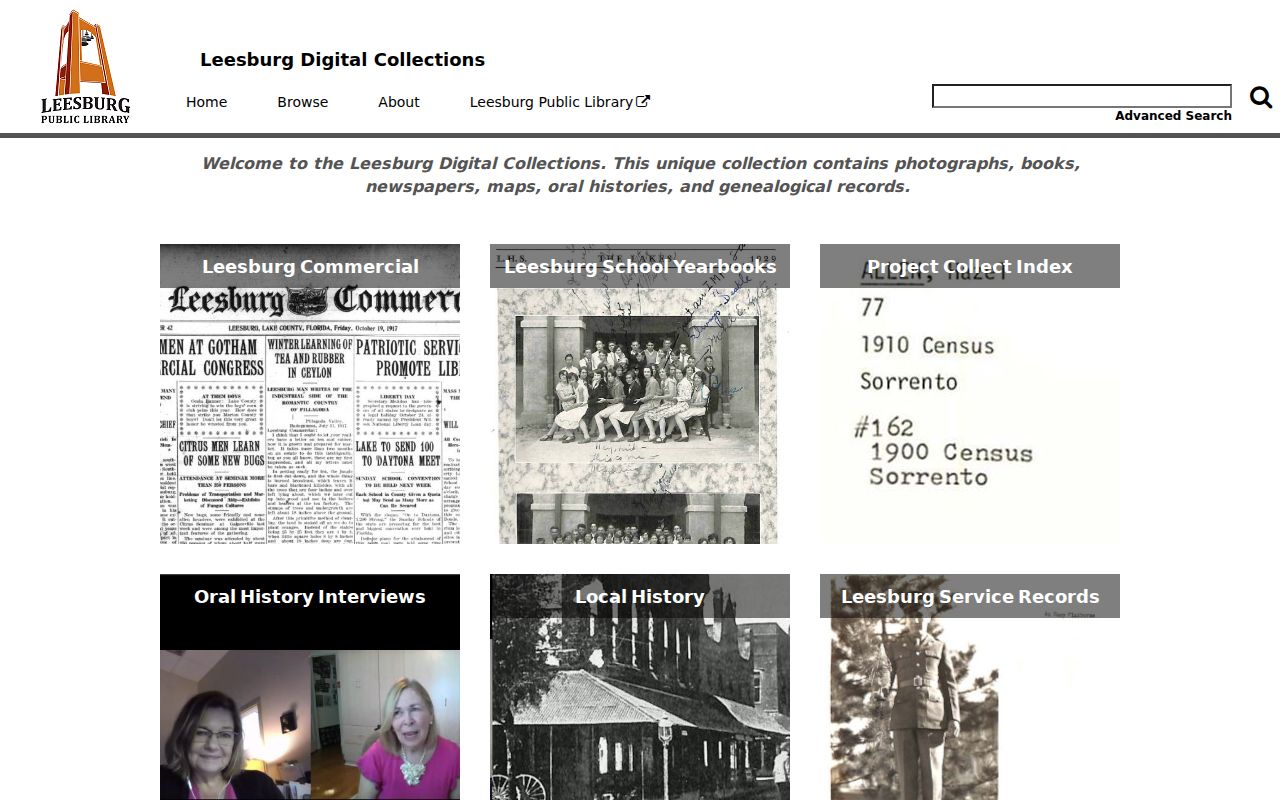
The library adds context without making historic records a current household roll.
Historical Leesburg Residents Directories
Verified holdings include 1924 to 1925, 1939, 1955, 1957, 1959 to 1960, 1962 to 1967, and a broad 1969 to 2019 run with gaps. Check each title page for its publisher. An entry may show surname, given name, spouse, work, and residence. Read “h,” “r,” and “wid” from that volume’s key.
A reverse section lists people by street and number, but not every volume is proven to have one. Check the contents. If a name is missing, try a spouse, business, variant, adjacent year, and street section. Absence can reflect incomplete coverage, not a move.
Sanborn maps add building shape, use, street labels, and numbering context. Leesburg editions are verified for 1885, 1890, 1895, 1901, 1906, 1911, and 1918. Pair a directory with a map and deed trail, then consult the Leesburg city directory collections.
Postal Leesburg Versus City Leesburg
A Leesburg mailing line does not prove a parcel is in city limits. City GIS stores PostalCity and JurisdictionCity separately, plus full address, unit, ZIP, lot, alternate key, location type, and status. Opposite sides of a road can even carry different ZIP and limit values.
ZIPs 34748 and 34788 extend beyond the city. PO-box ZIPs 34749 and 34789 are not neighborhoods. Use USPS for delivery, the parcel record for situs, and planning layers for jurisdiction. Annexation can make an old permit or directory label differ from today’s map.
Note: Keep postal city, jurisdiction, ZIP, situs, mailing line, and legal description separate in every Leesburg directory search.
Leesburg Name Match Checks
Common names need two independent matches. Preserve initials, suffixes, hyphens, former surnames, and reversed clerk indexing. Start exact, then broaden. Strong links include a parcel key, legal description, spouse, business number, middle initial, or continuous dates.
Roles matter. A grantor differs from a grantee. A plaintiff differs from a defendant. A registered agent is a company contact. A tax mailing line may be far from the land. Staff can explain access, but rarely can confirm that two matching entries are one human.
Business and license clues. Sunbiz can link a name with an entity, agent, officer, addresses, status, reports, and filing images. DBPR covers many regulated activities. Florida Treasure Hunt can show an owner name, reported address, holder, property type, and claim route.
These are leads, not residence proof. Officers may use offices, agents are service contacts, and old property may show an old address. Compare each clue with a parcel, dated filing, directory, or direct contact. Florida Treasure Hunt searches are free, though claims require proof.
Leesburg Public Records Requests
Florida’s Constitution and Chapter 119 support inspection and copying at reasonable times and conditions. A requester need not live in Florida or state a reason. There is no fixed response-day deadline. Access must be prompt, allowing reasonable time to find, review, and redact records.
Ask the custodian that keeps the item. The city clerk handles municipal material. The county clerk keeps deeds and court files. The Property Appraiser keeps tax-roll data, and elections staff keep voter records. Give type, subject, spelling, address, date span, format, and whether inspection is enough. Extensive work may carry a special-service charge, so seek an estimate.
Limits of Leesburg Resident Rolls
A deed chain lists owners, not all residents. Renters, relatives, boarders, and care-setting residents may never appear on the parcel roll. Registration omits nonvoters and protected voters and can lag a move. Court and vital records may be sealed, expunged, confidential, redacted, or limited to eligible people.
Safe at Home gives qualifying survivors a substitute mailing address and protections. Other statutes protect victim and occupational data. Requests cannot bypass those rules or open driver data. If an address vanishes, do not defeat the protection. Use records only for lawful personal work, genealogy, estates, civic inquiry, scam avoidance, or respectful reconnection.
When the trail ends, record the gap. “Unknown” is more accurate than joining two people merely because their names look alike.