
What Survives in Leesburg City Directory Collections
The local inventory establishes a long, irregular run rather than one seamless series. A useful city directory search starts by choosing a year that survives and noting its holder. Leesburg Public Library, local historical societies, and the library's Digital Collections divide access. The inventory mentions Polk and Hill-Donnelly at collection level, but the title page must be read before assigning a publisher to a year.
| Collection | Verified Years | Where Held | Access |
|---|---|---|---|
| Leesburg city directories | 1924-25; 1939; 1955; 1957; 1959-60; 1962-67; 1969-2019 | Public library and listed historical societies | Physical volumes and selected digital items |
| Sanborn maps | 1885, 1890, 1895, 1901, 1906, 1911, 1918 | Library of Congress | Free scans |
| Federal census | Decennial schedules through 1950 | NARA, FamilySearch, library databases | Public under the 72-year rule |
| Local papers and schools | Item-dependent | Leesburg Digital Collections | Free online |
| Official records | 1887 forward | Lake County Clerk, Tavares | Web, books, microfilm, images, counter |
Clear early gaps are 1926-38, 1940-54, 1956, 1958, 1961, and 1968. That is a holdings statement, not proof that no book was printed. Check the Kinseekers directory inventory and confirm the holder before a visit.
Leesburg City Directories in the Digital Collections
The Leesburg Public Library Digital Collections is the strongest online local-history gateway. Its groups include Local History, Leesburg Commercial excerpts, school yearbooks, Project Collect, oral histories, service scrapbooks, maps, photos, publications, and genealogy records. Search the exact surname first, then initials, spouse, street, school, unit, or group. Optical text can miss faint type, so browse a likely volume when search fails.
The local help path is shown by Kinseekers Genealogical Society.
That society link matters when a catalog clue, local spelling, or restricted image needs a human second look.
Decode a Leesburg City Directory Entry
Copy an alphabetical entry exactly before interpreting it. A line may contain surname, given name or initial, spouse in parentheses, work abbreviation, residence marker, and street address. A business line can name the shop and work address. The volume's own key controls every symbol.
| Name | Preserve initials, suffixes, spelling, and spouse notation. |
|---|---|
| Work | Copy occupation, employer, and abbreviations as printed. |
| Address | Record number and street; compare a street section if present. |
| Marks | “h” often means home, “r” may mean roomer or resides, and “wid” means widow. |
| Business | A work address is not automatic proof of a home address. |
- Criss-cross directory
- A street-and-number section rather than a surname list. Verify that the volume has one.
- Householder index
- An address-led list of a designated adult, not all people at the address.
- Abbreviation key
- The publisher's guide to marks and names; photograph it before decoding entries.
A missing person might have moved, died, been missed, lived outside coverage, or been filed under a spouse or firm. Absence from one Leesburg city directory does not prove a move.
How the Leesburg Directory Shelf Changes by Era
The evidence begins with maps before the verified directory run, then shifts from scattered early books to a fuller late-century shelf. These dates prove surviving access, not annual publication.
- 1885-1918: seven Sanborn editions show the built city.
- 1924-25: the earliest verified directory holding anchors the shelf.
- 1939: one year bridges a long gap.
- 1955-67: volumes appear often, though named gaps remain.
- 1969-2019: the inventory becomes much fuller, while holders still vary.
Lake County's 1887 creation adds context. Earlier facts may lie in Orange or Sumter records, though certified predecessor-county copies can also appear in Lake files.
Pair a Leesburg City Directory Address with Sanborn Maps
A directory names a person at a place; a Sanborn sheet describes that place. The verified ladder has one sheet in 1885, 1890, and 1895, two in 1901, three in 1906, five in 1911, and four in 1918. The rising count charts urban spread.
Maps show outlines, size, materials, use, street width, property lines, numbers, and fire or water systems. Match the entry to the closest map year, then compare later sheets. A number change or rebuilt site may explain why a listing seems to vanish. The map adds context but is not a roll of residents.
Get Leesburg City Directory Help at the Library
Leesburg Public Library at 100 E. Main Street is a holder and access point. Call 352-728-9790. Kinseekers volunteers offer free genealogy help Wednesdays from 10 a.m. to 1 p.m., with no appointment stated. Bring names, a rough year, and any address, school, spouse, subdivision, or business clue.
The library is a FamilySearch Affiliate Library. A key icon that blocks a catalog image at home may become viewable at its terminals. The State Library city-directory collection is a second holdings route; call its reference desk at 850-245-6682 before travel.
The statewide collection page shows the catalog route.
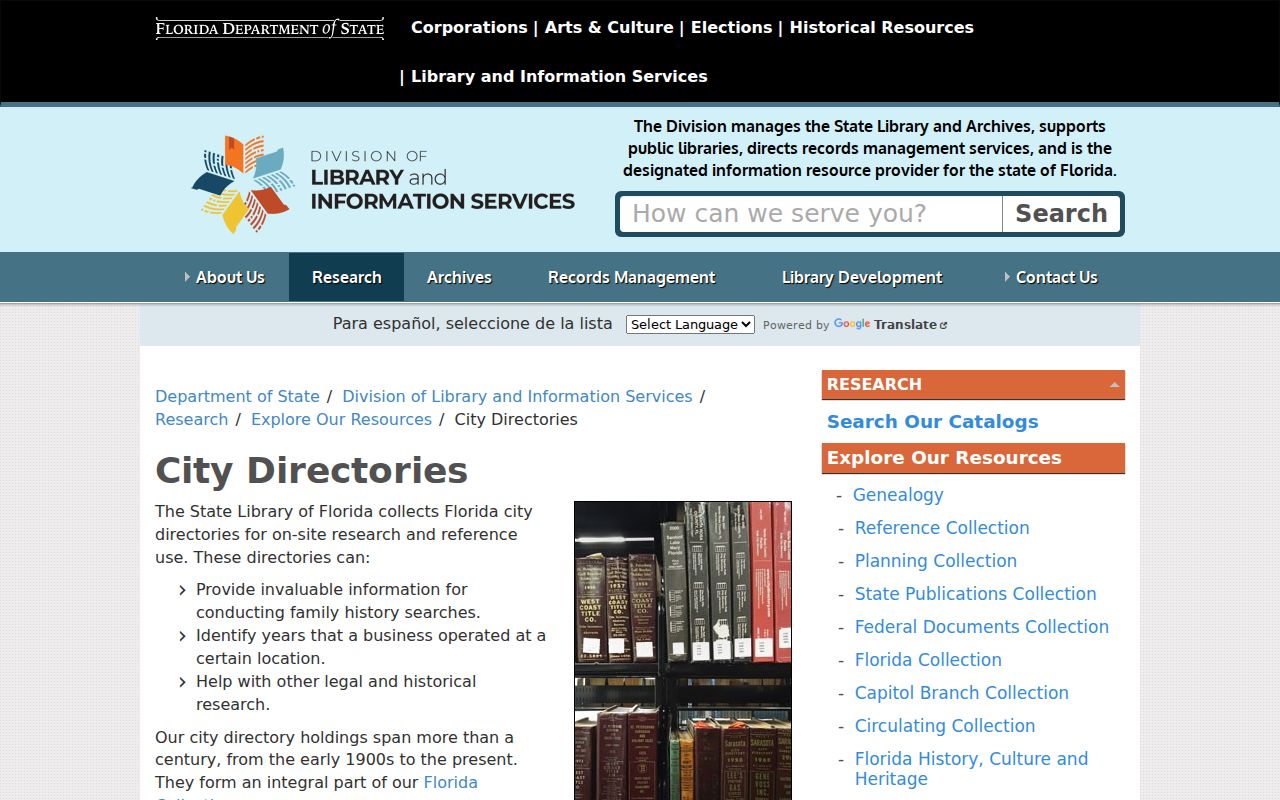
Ask for a Leesburg holdings check, then record city, year, publisher, holder, and call data.
Leesburg People Beyond the Printed Shelf
Project Collect and service scrapbooks preserve evidence outside standard directories. Project Collect is a name-led gateway to settlers and early Lake County material. Service files can hold units, clippings, photos, correspondence, and local ties. Oral histories add voice, while Leesburg Commercial excerpts reveal notices, obituaries, clubs, shops, and family events.
Yearbooks can resolve a classmate through initials, graduation year, activities, and associates. Current civic or church lists are voluntary only when a group publishes them. Historic rosters given to an archive have a different purpose and access setting.
Work outward from the strongest known fact. A school year and activity may lead to a yearbook page; a service branch may lead to a scrapbook; an old store name may lead to a newspaper notice. Record the collection name, item title, date, page, and stable link while viewing it. Names in captions and handwritten cards can use initials or nicknames that a government index does not. Compare those variants with the printed household listing before deciding they identify one person.
The library material is most useful when it explains relationships and community context that terse indexes omit. It can show how a resident was connected to a school, business, unit, club, or event without turning that context into proof of a later address. When an item names living relatives or a sensitive event, verify the core fact through the proper custodian and share it with care.
Trace a Family Through Leesburg City Directories
A sound trail builds a chain, not one hit. Pair close publication years, use the census for household detail, and maps for the site. Since 1950 is the newest public federal population schedule, later work leans on directories, deeds, papers, permits, and probate.
- Find a likely alphabetical entry and transcribe every mark.
- Read the title, coverage note, and key; compare adjacent surviving years.
- Test the address in a reverse section only if the volume has one.
- Pair the trail with 1900-1950 census schedules and nearby Sanborn editions.
- Use papers, probate, obituaries, and official records to explain changes.
For modern identity checks, use the Leesburg resident lookup. For a modern road-wide task, the Leesburg street directory keeps the address angle separate.
Why Leesburg City Directory Searches Reach Dead Ends
Compilers missed people. Children may be absent, boarders omitted, and a family listed under one adult. Postal Leesburg, historic limits, and current city limits are not the same geography. Rapid growth and annexation make the coverage question vital.
Research rule. Treat each listing as a dated clue, keep failed searches in context, and require an independent source before joining same-name records.
The best result is a cited volume, year, exact line, decoded key, known coverage, and tested link to another record.